Guarda wallet security: backup and recovery safety
Guarda wallet security Is about protecting backup and recovery access
Guarda wallet security Is the practice of keeping your encrypted backup file, password, device, and recovery workflow protected so only you can restore and control your crypto wallet. Because Guarda is a self-custody wallet, the most important safety habit is simple: treat the backup file and password as sensitive access materials, store them separately, avoid cloud exposure unless encrypted, and verify every restore step through official Guarda channels before moving funds.
Guarda wallet security matters because a software wallet is convenient only when the recovery path is understood before something goes wrong. A lost laptop, damaged phone, forgotten password, or corrupted backup file can turn a normal login problem into a serious custody problem. The goal is not fear; the goal is a practical routine that reduces avoidable mistakes while still letting you use the wallet for storage, swaps, staking, and transfers.
Guarda wallet security also depends on the user accepting the reality of self-custody. A custodial exchange may reset access after identity checks, but a non-custodial wallet normally cannot recreate private keys for you. In this model, the wallet interface helps you manage assets, but the recovery materials are the real lifeline. That is why a careful backup workflow is just as important as the app password itself.
What is Guarda wallet security?
Guarda wallet security refers to the set of choices that protect a Guarda wallet from account loss, unauthorized access, phishing, malware, device failure, and careless recovery attempts. It includes how the wallet is created, how the password is chosen, where the backup file is stored, how often backups are updated, and how recovery is tested. It also includes the judgment to slow down before entering wallet information into any website, form, or support conversation.
Guarda wallet security is different from a bank password because the password may be connected to encrypted key material rather than a normal resettable account. In many Guarda workflows, a backup file and password are needed together to restore access. That pairing is powerful because neither item should be useful alone, but it also means losing either one can create a recovery problem. Users should verify the exact current process in the official Guarda app or website because wallet products can change over time.
Guarda wallet security starts before funds arrive. A new user should confirm they are downloading the correct application, avoid sponsored search traps, update the operating system, and use a device that is not already infected or shared casually. The first deposit should usually be small enough to test receiving, sending, and restoring confidence before larger balances are involved.
How does Guarda wallet security work with passwords and backup files?
Guarda wallet security works by combining local wallet access controls with encrypted recovery material. The password protects the encrypted wallet data, while the backup file supports restoration if the original device is lost or the wallet has to be imported again. In practical terms, a person restoring the wallet generally needs both the correct file and the correct password, so storage discipline becomes the central safety habit.
Guarda wallet security is strongest when the password is unique, long, and not reused from email, exchanges, social accounts, or password manager master passwords. A short memorable phrase may feel convenient, but crypto theft often follows predictable password behavior. A better approach is a long passphrase with unrelated words or a generated password kept in a reputable password manager, plus an offline emergency copy stored where only the owner or a trusted estate plan can reach it.
Guarda wallet security also depends on treating the backup file as a secret, not as a harmless document. A plain file sitting in downloads, email attachments, messaging apps, or unencrypted cloud folders is easy to forget and easy to expose. A safer pattern is to keep the file in encrypted storage, maintain at least one offline copy, and label it clearly enough for recovery without writing the password on the same drive or sheet.
For more detail on handling recovery materials, a related can help frame the difference between availability and exposure. The best Guarda wallet security setup balances both: you need the backup to survive hardware failure, but you do not want a thief, malware operator, or curious coworker to find a complete recovery package.
Is Guarda wallet security safe for everyday crypto use?
Guarda wallet security can be suitable for everyday crypto use when the user follows careful self-custody practices and understands software wallet limits. A desktop or mobile wallet is usually more convenient than a hardware wallet, but it also lives on an internet-connected device that may run browsers, extensions, email, games, and other software. That broader attack surface is the tradeoff.
Guarda wallet security should be evaluated by use case. For small active balances, quick transfers, swaps, and routine portfolio management, a software wallet may be practical. For larger long-term holdings, many users prefer a hardware wallet or a split setup where the software wallet holds only spending funds. Guarda has supported hardware wallet connectivity in some contexts, but users should verify current supported assets and devices directly in official product documentation before relying on that feature.
Guarda wallet security is not a promise that every loss can be reversed. Blockchain transfers are usually final, token contracts can be risky, fake apps can mimic legitimate brands, and phishing pages can look polished. The safer mindset is to assume every send transaction, restore prompt, and wallet export deserves a pause. Crypto values move, software changes, and third-party integrations can change, so users should verify details with official sources before making financial decisions or transferring meaningful balances.
How should a new user set up Guarda wallet security?
Guarda wallet security during setup should be slow, documented, and boring. The riskiest first-time mistake is rushing through backup prompts because the wallet appears empty. Empty wallets are exactly when users should learn the recovery process, because there is no pressure and no balance at risk. A careful setup also makes later troubleshooting far less stressful.
Guarda wallet security improves when setup follows a repeatable workflow. The exact screens may vary by platform, so the user should follow the current Guarda interface while keeping these general steps in mind:
Confirm the official Guarda source before downloading or opening a wallet page.
Create a unique, high-entropy password that is not reused anywhere else.
Save the backup file immediately and remove stray copies from downloads if needed.
Store the backup file and password separately, preferably with offline redundancy.
Test the restore process with a low-value wallet or before depositing substantial funds.
Record the date, device, and platform used so future recovery is easier to reason about.
Guarda wallet security is easier to maintain when the owner avoids mixing daily clutter with recovery files. A folder named casually on a work desktop, a USB drive tossed into a drawer, or an attachment sent to yourself may feel convenient, but each choice creates a trail. Encrypted removable media, secure password manager notes, and a written recovery inventory can be more deliberate without becoming complicated.
What are the main use cases for Guarda wallet security?
Guarda wallet security supports several ordinary wallet jobs: storing multiple assets, receiving payments, moving tokens between chains or exchanges, participating in staking where available, and restoring access after device loss. These use cases all share the same foundation. The wallet can be useful only if the owner can access it reliably and prevent others from doing the same.
Guarda wallet security is especially relevant for multi-asset users because more networks mean more chances to make operational mistakes. A Bitcoin receiving address, an Ethereum token transfer, and a staking operation can involve different fee rules, confirmation times, and network assumptions. Users should double-check the network, address, and asset before sending, because a technically valid transaction can still be wrong for the intended destination.
Guarda wallet security also matters for people who travel, replace phones often, or use both desktop and mobile devices. If a device disappears, the recovery process should not depend on memory alone. A user who has planned ahead can restore calmly from the backup file and password. A user who has not may end up searching old downloads, email, or cloud drives under pressure, which increases the chance of entering information into the wrong place.
What risks can weaken Guarda wallet security?
Guarda wallet security can be weakened by the same problems that affect many crypto wallets: phishing, malware, reused passwords, exposed backups, fake support, clipboard hijacking, malicious browser extensions, and rushed transaction approvals. None of these require a dramatic technical failure. Many losses begin with one small convenience, such as saving a recovery file in a synced folder or trusting a link from a search result.
Guarda wallet security also depends on avoiding recovery theater. A person who cannot log in may become willing to try any tool that promises a quick fix. That is dangerous. No legitimate helper should need unrestricted access to your complete wallet materials, and no website should be trusted simply because it has the right logo. If recovery requires support, users should reach official channels directly and avoid sharing sensitive wallet contents.
Guarda wallet security can also fail through poor update habits. An outdated operating system, abandoned browser extension, unpatched phone, or old wallet version may increase risk. Updates should still be handled carefully: verify the source, read important notices, and avoid installing wallet software through random mirrors or unofficial app bundles. Security is not just having the latest version; it is knowing where that version came from.
How does Guarda wallet security compare with hardware wallets and exchanges?
Guarda wallet security sits between two familiar models: custodial exchanges and hardware wallets. An exchange may be easier for password resets and fiat services, but the exchange controls withdrawal policies and account access. A hardware wallet usually gives stronger isolation for private keys, but it adds a physical device, firmware process, seed phrase handling, and sometimes more friction. A software wallet like Guarda emphasizes convenience while keeping self-custody responsibilities with the user.
Guarda wallet security may be a good fit for active users who want control without carrying a dedicated signing device for every small transaction. It may be less appropriate as the only protection for a large long-term balance on a general-purpose computer. Many experienced users separate roles: a hardware wallet for deep storage, a software wallet for regular activity, and an exchange only for services that require custody.
Option
Typical strength
Typical tradeoff
Software wallet
Convenient self-custody and fast access
Depends heavily on device hygiene and backup habits
Hardware wallet
Private keys stay better isolated from daily devices
Requires device management and careful seed storage
Custodial exchange
Account recovery and integrated services may be easier
User relies on the custodian for access and withdrawals
Guarda wallet security is therefore not a one-size-fits-all answer. The better question is what balance, frequency of use, technical comfort, and recovery plan the user has. A clear personal policy can prevent improvisation: keep only active funds in the software wallet, test every new address with a small amount, and move larger dormant balances to a setup designed for long-term storage.
What should you do before restoring a Guarda wallet?
Guarda wallet security becomes most important during restoration because the user is often under stress. Before restoring, confirm that the device is clean, the internet connection is trusted, the app or website is official, and the backup file has not been modified. Do not paste wallet materials into chat tools, generic password recovery sites, browser pop-ups, or forms sent by strangers.
Guarda wallet security during recovery should include a calm inventory. Identify the most recent backup file, confirm where the password is stored, and avoid overwriting files until the wallet is visible again. If multiple backup files exist, keep them intact while determining which one corresponds to the wallet you need. Deleting old files too early can remove clues that would have helped later.
Guarda wallet security also benefits from a low-risk verification after restore. Once access appears to be back, check receiving addresses, balances, and transaction history before sending funds. If anything looks unfamiliar, stop and investigate. For broader recovery planning, an internal can help users think through device loss, password uncertainty, and backup storage without relying on guesswork.
How can Guarda wallet security stay strong over time?
Guarda wallet security is not finished after setup. It should be reviewed whenever you change devices, move homes, change password managers, update estate documents, or increase the value held in the wallet. A setup that was acceptable for a small test balance may be inadequate for a larger portfolio. The security routine should scale with the risk.
Guarda wallet security can be maintained with periodic checks that do not expose secrets. Confirm that backup storage still works, that the password can be located by the right person, that no complete recovery package sits in one obvious place, and that old devices have been wiped before disposal. Avoid opening recovery files unnecessarily on internet-connected machines, but do verify that the storage media has not physically failed.
Guarda wallet security also includes planning for trusted access in emergencies. Crypto self-custody can create an estate problem if nobody else knows that recovery materials exist. The answer is not to share secrets casually. The answer is a controlled plan, such as sealed instructions, legal estate documents, or a trusted emergency process that separates the password from the backup file until access is truly needed.
Why Guarda wallet security should be practical, not complicated
Guarda wallet security works best when the routine is simple enough to follow on a bad day. A perfect plan that nobody can understand will fail. A practical plan names the wallet, preserves the backup file, protects the password, separates storage locations, verifies official sources, and limits the amount kept on an everyday device. Those habits address the most common causes of preventable wallet loss.
Guarda wallet security should also leave room for personal risk tolerance. Some users are protecting a small spending balance. Others are managing long-term holdings, staking rewards, or assets across several networks. The same principles apply, but the level of redundancy, hardware isolation, documentation, and review should increase as the amount at risk increases.
Guarda wallet security finally comes down to ownership. The wallet can provide tools, encryption, and recovery flows, but the user controls the environment where those tools are used. Verify current instructions with official Guarda sources, avoid guaranteed recovery claims, never share sensitive wallet materials casually, and practice restoration before the wallet becomes difficult to replace. With that approach, Guarda wallet security becomes a manageable routine rather than a crisis plan.
Reader rating:
4.5 / 5
based on 991 ratings
Questions and Answers
What does Guarda wallet security mean for a self-custody user?
Guarda wallet security means protecting the materials that control wallet access, especially the password, encrypted backup file, device, and recovery workflow. Since self-custody wallets generally cannot reset access like a bank account, the user must preserve recovery information and prevent unauthorized access. The safest approach is to store backup materials separately, verify official sources, and test low-risk workflows before holding larger balances.
Do I need both a Guarda backup file and password to recover access?
In many Guarda recovery workflows, the backup file and the correct password work together to restore wallet access. That is why both items must be protected and preserved. Users should verify the current official Guarda instructions because wallet products and screens can change. As a general safety rule, avoid storing the password and backup file in the same unencrypted location.
Is Guarda wallet security enough for large crypto balances?
Guarda wallet security can be appropriate for active self-custody use, but large long-term balances may need stronger isolation, such as a hardware wallet or a layered storage plan. Software wallets run on everyday devices, so they depend heavily on device hygiene, password quality, and backup handling. Users should assess their own risk tolerance and verify details with official sources before transferring meaningful funds.
Where should I store a Guarda wallet backup file?
A Guarda wallet backup file should be stored somewhere durable, private, and protected from casual access. Many users prefer encrypted removable storage plus a separate emergency copy, with the password kept somewhere else. Avoid leaving backup files in downloads folders, email attachments, unencrypted cloud storage, or shared devices. The goal is to keep the file available for recovery without creating an easy path for theft.
What are the biggest risks to Guarda wallet security?
The biggest risks include phishing pages, fake wallet apps, malware, exposed backup files, weak or reused passwords, malicious browser extensions, and rushed recovery attempts. A user may lose funds even when the wallet software itself is working properly if sensitive information is entered into the wrong place. Always verify official sources, inspect transaction details, and avoid sharing wallet materials with anyone claiming quick recovery guarantees.
How often should I review my Guarda wallet security setup?
Review Guarda wallet security whenever you change devices, increase balances, move backup storage, change password managers, or update your estate plan. A periodic check can confirm that the backup file still exists, the password can be found, old devices are wiped, and no complete recovery package is exposed in one place. The review should not require repeatedly opening secret files on unsafe devices.
Can customer support recover a Guarda wallet if I lose my password?
Self-custody wallet support is usually limited because the provider should not hold the private materials needed to recreate your wallet. If the password or backup file is missing, recovery may be difficult or impossible depending on the situation. Contact only official support channels, never share complete sensitive materials casually, and be cautious of anyone promising guaranteed wallet recovery.
As more people enter the cryptocurrency market, there has been an explosion of high-quality self-custodial wallet applications. Although software wallets aren’t as hack-proof as hardware wallets like KeepKey or Ledger, they are convenient and secure ways for people to take ownership of their digital assets. Plus, most of today’s top-rated software crypto wallets are free to download on desktop and mobile devices.
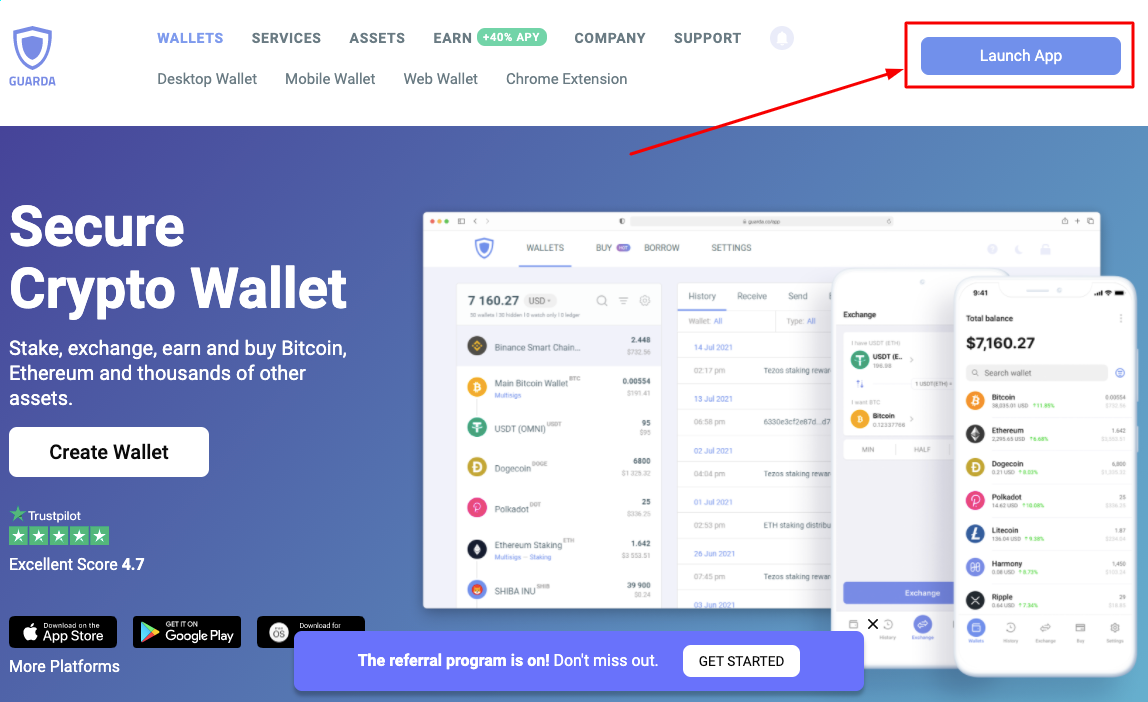
The Guarda Wallet is one example of a highly versatile and popular multi-blockchain software crypto wallet. Many beginners praise Guarda Wallet for its intuitive interface, simple set-up process, and bonus features like in-app crypto staking. Unlike many competing software wallets, Guarda never shows the secret mnemonic seed phrase to wallet users. Instead, the Guarda Wallet team chose to give each user a “master private key” that is encrypted with the user’s password. This makes it easier for people to store and remember this crucial information. Everyone who uses the Guarda Wallet also receives a backup file if they ever need to restore their account.
Whether you’re considering downloading the Guarda Wallet or already have an account, this guide will answer all the basic questions about setting up and using the Guarda app. We’ll also run through a few basic troubleshooting scenarios so you know how to recover your Guarda Wallet.
What Is the Guarda Crypto Wallet?
The Guarda Wallet is a software crypto wallet that works on desktop and mobile settings. When Paul Sokolov launched Guarda in 2017, this wallet only worked within Ethereum’s ecosystem. However, as Guarda’s popularity grew, it has become a multi-blockchain wallet capable of storing over 10,000 coins and tokens. In addition to Ethereum and ERC-20 tokens, Guarda Wallet users can store many prominent virtual currencies like
Bitcoin
,
Litecoin
, and
Dogecoin
.
Guarda users can purchase crypto directly with a credit or debit card or apply for Guarda’s prepaid Visa card. Guarda users also have the option to swap dozens of cryptocurrencies on the Guarda Wallet thanks to its integration with the exchange ChangeNOW. Thirdly, Guarda supports staking dozens of cryptocurrencies so investors can earn interest on their favorite projects. A few coins and tokens now available for staking rewards on Guarda include Ethereum, Cosmos, Cardano, and Tezos.
For even more security, Guarda Wallet integrates with the hardware wallet manufacturer Ledger. Anyone who has a Ledger device can link it to their PC, open their Guarda account, and select the “Connect” button near the Ledger icon. Simply choose any of the cryptocurrencies listed on your screen to connect your Ledger account to your Guarda Wallet.
Currently, Guarda supports the following digital assets through its Ledger connect feature:
Bitcoin
Ethereum
Binance Coin
Ethereum Classic
Litecoin
Callisto
Setting Up a New Guarda Wallet: A Step-by-Step Guide
The first step to creating a new Guarda account is to visit thewallet’s main website at
www.guarda.com
. On Guarda’s homepage, you’ll find a bright “Create Wallet” button leading you through the straightforward set-up process. According to Guarda’s website, you can download this wallet on any of the following desktop and mobile systems:
MacOS
iOS
Windows
Debian
Linux
Android
Chrome extension
AppGallery
Ubuntu
Once you’ve chosen your preferred operating system, Guarda will prompt you to create a password for your new wallet. The password you choose will automatically link to your wallet’s encrypted private key, which serves as the “master private key” for all of the crypto in your Guarda account. The master private key in your Guarda Wallet gives you complete control over the cryptocurrencies in your account, so it’s extremely important to keep it secure. Guarda asks new users to take their time creating a
strong password
and to write it down before moving on to the next step.
After writing down your password, your Guarda Wallet will supply you with a “backup file” in a TXT format. As the name suggests, the backup file contains the necessary information on your private keys, and you can use it to recover your Guarda Wallet. Download your backup file and store it in a safe place, such as an encrypted USB drive.
Once you have your secret passphrase and backup file in secure places, your Guarda Wallet should be ready for transferring, storing, staking, and purchasing cryptocurrencies. If you have any issues creating a Guarda Wallet account, consider contacting a Guarda customer care member via their
official Contacts page
.
How Do You Recover Crypto From a Lost Guarda Wallet?
As mentioned above, each Guarda wallet has two vital pieces of information:
Password
Backup file
If you break your phone or computer and need to re-download your Guarda Wallet, first visit Guarda’s official website and click either “Create Wallet” or “Sign In.” Instead of creating a new Guarda account, select “Restore or Import” to recover your lost Guarda account. On this page, you must place your backup file in the provided field and type your password. After you click the “Restore” button, your old Guarda account should appear on your computer screen or mobile device.
Can’t Get Into Your Guarda Wallet? Reach Out to ReWallet!
If you’re having difficulty recovering your Guarda Wallet, there may be ways ReWallet’s team can help you get into your account. For instance, if you have an incorrect passphrase or a corrupted backup file, it’s still possible to restore a Guarda Wallet. The only instance where ReWallet can’t help clients is if they’ve misplaced their backup file.
Anyone struggling to recover crypto in their Guarda Wallet should consider contacting professional
wallet recovery services
like ReWallet to assess their individual situation. After reading about your situation, an expert from ReWallet’s team will let you know what’s going on with your wallet and the best way to move forward.
Bruno Krauss
Co-founder and CTO Bruno is a crypto native. Long before the public hype around Bitcoin, Ethereum & Co, Bruno was already active in crypto. The idea for ReWallet originated from losing access to his own wallet.