Guarda wallet Is a self-custody setup, backup, and recovery guide
Guarda wallet Is a non-custodial cryptocurrency wallet used to store, send, receive, swap, buy, stake, and manage digital assets across multiple networks. The key point is that Guarda wallet gives the user control over access credentials, so setup and backup matter as much as the app itself. To use it responsibly, create the wallet from official sources, save the encrypted backup file, protect the password, and verify current details with Guarda's official materials before moving funds.
Guarda wallet sits in the category of software wallets, which means it runs on devices such as phones, desktop computers, browser environments, and supported operating systems rather than existing as a dedicated hardware device. That convenience makes Guarda wallet approachable for everyday portfolio management, but it also means the security of the device, password, backup file, and user habits directly affects the safety of the assets.
What is Guarda wallet?
Guarda wallet is a self-custody crypto application designed for people who want one place to manage many coins and tokens. Unlike an account on a centralized exchange, Guarda wallet is built around user-controlled access. In ordinary language, the wallet helps create and manage the cryptographic keys that authorize transactions, while the coins themselves remain recorded on their respective blockchains.
Guarda wallet is commonly discussed as a multi-currency wallet because it supports a broad range of blockchain assets rather than focusing on only one network. A person might use Guarda wallet for Bitcoin, Ethereum-based tokens, Litecoin, Dogecoin, or other supported assets, depending on the current app version and network availability. Because asset support can change, users should always confirm the latest list inside the official app or official help resources before depositing a coin.
The phrase self-custody is important. Guarda wallet does not remove the basic responsibility that comes with crypto ownership. If a password is forgotten, a backup file is lost, or a device is compromised, recovery may become difficult or impossible. Guarda wallet can make the workflow simpler, but it cannot turn a private-key system into a bank-style password reset service.
How does Guarda wallet work?
Guarda wallet works by creating wallet access data that lets the user control blockchain addresses. Instead of treating the app like a regular web login, it helps the user manage encrypted private key information. The app interface may show balances, transaction history, receiving addresses, token lists, exchange features, staking options, and settings, but the deeper function is key management and transaction signing.
When someone sends crypto from Guarda wallet, the app prepares a transaction for the relevant network. The user reviews details such as the asset, recipient address, amount, and network fee, then authorizes the transaction. Once broadcast, confirmation depends on the blockchain. Guarda wallet can display the transaction status, but it does not control miner fees, validator behavior, congestion, or irreversible settlement rules.
Guarda wallet also includes account recovery mechanics based on the password and backup file model. That differs from many wallets that emphasize a seed phrase as the main recovery item. The practical result is simple: anyone using Guarda wallet should understand exactly what file was downloaded during setup, what password protects it, where both are stored, and how to restore the wallet before an emergency happens.
What can you use Guarda wallet for?
Guarda wallet is mainly used for routine crypto management. A typical user opens Guarda wallet to check balances, receive payments, send funds, swap one asset for another, buy supported assets through integrated providers, or explore staking where available. These features are convenient, but each one depends on network rules, partner terms, availability by region, and changing market conditions.
Guarda wallet can also be useful for separating long-term custody habits from exchange trading habits. For example, a user may buy assets elsewhere and move a portion to Guarda wallet for personal custody. Another user may keep only a small operational balance in a software wallet while storing larger amounts in a hardware wallet. There is no universal best setup, because device security, experience level, asset type, and risk tolerance all matter.
Receiving crypto to a wallet address controlled through the app.
Sending supported assets after checking the address and network carefully.
Viewing transaction history and balances across enabled wallets.
Using supported swap, purchase, or staking features when available.
Restoring access with the correct backup file and password.
For related preparation, a plain-language can help users think through storage choices before they put meaningful value into any wallet. Guarda wallet should be part of a broader custody routine, not a standalone shortcut around careful record keeping.
How to get started with Guarda wallet
Guarda wallet setup begins with choosing the correct version for the device and downloading it from an official source. This step is not just administrative. Fake wallet downloads, copied websites, malicious browser extensions, and phishing messages are common risks in crypto. Before creating a wallet, check the spelling of the site, the publisher details, and the current official instructions.
After installation, Guarda wallet prompts the user through wallet creation. The most important setup choice is the password. A strong password should be unique, long, hard to guess, and stored somewhere safer than a note app or screenshot folder. Guarda wallet uses this password as part of the encrypted access process, so a weak or forgotten password can become a serious problem.
Guarda wallet then provides a backup file that needs to be saved securely. Users should not treat this file as a disposable download. The backup file and password work together, so each should be protected from loss and theft. For some people, that means encrypted removable storage. For others, it means multiple offline copies in controlled locations. The correct approach depends on the value stored and the user's ability to maintain access over time.
Before receiving a large amount, Guarda wallet users should test the workflow with a small transfer. Send a small amount in, confirm it appears, and learn how the history and receive screens behave. If practical, review the restore process on a separate safe device before relying on the wallet for meaningful balances. Small tests are not perfect protection, but they catch simple mistakes early.
How does Guarda wallet backup and recovery work?
Guarda wallet recovery depends on having the right backup file and the right password. If a phone breaks, a computer is replaced, or the app needs to be reinstalled, the user should install Guarda wallet from an official source and choose the restore or import path rather than creating an unrelated new wallet. The backup file is then provided to the app, and the password is entered to unlock the encrypted wallet data.
Guarda wallet recovery can fail when the wrong backup file is used, the password is mistyped, the file is corrupted, or the user accidentally saved an empty or outdated file. It can also become more complicated if malware, device failure, cloud sync errors, or file renaming made the backup harder to identify. This is why a recovery plan should be checked while access still works.
The recovery process should be handled in a private environment. Do not upload a Guarda wallet backup file to unknown websites, do not share it with strangers, and do not type the password into links sent through messages or social media. A legitimate recovery workflow should keep sensitive material under the user's control. Anyone facing a high-value recovery problem should slow down and verify every step through official sources.
People who are new to wallet recovery often confuse backup files, passwords, seed phrases, private keys, and exchange logins. A separate may help with the vocabulary, even though Guarda wallet has its own backup model. The main idea is the same across self-custody tools: whoever can unlock the wallet credentials may be able to move the funds.
Is Guarda wallet safe?
Guarda wallet can be used safely when the device, password, backup file, and transaction habits are handled carefully. It is a non-custodial wallet, so the design reduces reliance on a third party holding the user's assets. That is a benefit for control, but it also removes many familiar account recovery protections. Guarda wallet safety is therefore a shared result of software design and user behavior.
Guarda wallet users should keep operating systems updated, avoid installing unknown software, use device-level security, and be cautious with browser extensions. A compromised computer can expose wallet activity even if the wallet app itself is legitimate. Screenshots, copied passwords, cloud-synced downloads, and reused credentials can also weaken a backup plan. The safest setup is boring, consistent, and difficult for an attacker to access.
Guarda wallet transactions should be reviewed before approval. Crypto transfers are usually irreversible, and a correct-looking first few characters of an address are not enough. Check the full address when possible, confirm the network, understand fees, and beware of tokens or messages that pressure immediate action. Guarda wallet can present transaction details, but it cannot guarantee that a user intended the recipient or asset route.
There is also market risk. Holding crypto in Guarda wallet does not protect against price volatility, protocol failures, smart contract issues, bridge failures, staking risks, or changing laws. This page is informational and not financial advice. Users should verify current product details, supported networks, fees, and risk disclosures with official sources before making decisions.
Fees and costs of Guarda wallet
Guarda wallet may be free to download, but using crypto networks is not free. Sending assets normally requires a network fee paid to miners or validators, depending on the blockchain. Those fees can change quickly during congestion. Guarda wallet may show estimated fees in the interface, but the final cost depends on the network and the transaction settings available at the time.
Guarda wallet features such as buying, swapping, or staking may involve provider fees, spreads, minimums, commissions, or validator-related terms. These costs are not always the same as a simple wallet-to-wallet transfer. A user comparing options should review the quote screen, check the asset received, look for rate differences, and understand that third-party services integrated into a wallet can have their own rules.
Guarda wallet users should also consider the hidden cost of mistakes. Sending an asset on the wrong network, ignoring a memo or tag where required, approving a malicious transaction, or losing the backup file can be more expensive than a visible fee. In practice, the lowest-cost wallet workflow is usually the one that is careful, verified, and tested with small amounts first.
Guarda wallet compared with other wallet choices
Guarda wallet is one option among several custody models. A centralized exchange account may feel easier because it has a familiar login and customer support flow, but the user generally does not have the same direct control over private keys. A hardware wallet can offer stronger isolation for key storage, but it requires purchasing and managing a separate device. Guarda wallet sits between those worlds as a flexible software wallet for everyday access.
Compared with single-chain wallets, Guarda wallet may appeal to users who hold assets across several networks and want fewer apps. Compared with a hardware wallet, Guarda wallet is more convenient but more exposed to device and malware risk. Compared with an exchange, Guarda wallet gives more custody control but less account recovery convenience. The best choice often involves using more than one tool for different balances and purposes.
Guarda wallet may also be paired with hardware wallet workflows where supported, which can improve the custody model for some users. Still, compatibility and supported assets should be checked directly in the current app and official documentation. Crypto software changes often, and a feature that worked for one asset or device may not apply to another.
When Guarda wallet makes sense
Guarda wallet makes sense for users who want a broad self-custody wallet and are willing to take backup seriously. It is especially relevant for people who want a practical interface for multiple assets without relying entirely on an exchange. Guarda wallet is less suitable for anyone who is unwilling to protect files and passwords or who expects a simple customer-service reset after losing credentials.
For a new user, the best Guarda wallet workflow is measured and deliberate. Install from official sources, create a strong password, secure the backup file, test receiving and sending with small amounts, learn the recovery process, and keep records private. Guarda wallet can be a useful part of a crypto routine, but its value depends on disciplined custody habits.
Guarda wallet should be approached as a tool, not a guarantee. It can help manage digital assets, but it cannot eliminate blockchain risk, user error, malware, bad addresses, volatile markets, or changing service terms. The practical takeaway is simple: use Guarda wallet only after understanding how access, backup, recovery, and transaction approval work, and verify current information with official Guarda sources before moving significant funds.
Reader rating:
4.5 / 5
based on 991 ratings
Questions and Answers
What is Guarda wallet used for?
Guarda wallet is used to manage cryptocurrency in a self-custody software wallet. Users can receive, send, store, swap, buy, and in some cases stake supported assets, depending on the current app and network availability. It is not the same as an exchange account because the user is responsible for protecting the wallet access data, password, and backup file.
How do I recover a Guarda wallet?
To recover a Guarda wallet, you generally need the correct backup file and the password that protects it. Install the official app or use the official restore path, choose restore or import, provide the backup file, and enter the password. If either item is missing, incorrect, corrupted, or exposed, recovery may fail or become risky.
Does Guarda wallet use a seed phrase?
Guarda wallet is commonly associated with an encrypted backup file and password model rather than the standard seed phrase workflow used by many other wallets. Users should follow the current instructions shown by the official app, because wallet versions and recovery details can change. The important point is to save the required recovery material securely before depositing meaningful funds.
Is Guarda wallet safe for crypto storage?
Guarda wallet can be safe when used with strong device security, a unique password, protected offline backups, and careful transaction review. It is still a software wallet, so malware, phishing, lost files, weak passwords, and user mistakes remain real risks. For large balances, many users compare software wallets with hardware wallet storage and other custody methods.
What happens if I lose my Guarda wallet password?
If you lose the Guarda wallet password, access may be difficult because the password helps unlock the encrypted wallet data. A backup file alone may not be enough if the password cannot be recovered. Users should avoid sharing files or passwords with unknown services and should verify any recovery option through official sources before attempting a high-value recovery.
Are there fees to use Guarda wallet?
Downloading Guarda wallet may be free, but transactions usually involve blockchain network fees. Buying, swapping, or staking through integrated services may also involve provider fees, spreads, minimums, or validator terms. The exact cost can change by asset, network congestion, region, and service provider, so users should review the transaction screen before approving anything.
Can Guarda wallet hold many different cryptocurrencies?
Guarda wallet is designed as a multi-currency wallet and supports many blockchain assets, but users should verify the current asset list inside the official app or official help materials. Support can vary by platform, network, token type, and app version. Before sending funds, confirm the asset, network, address format, and any required memo or tag.
As more people enter the cryptocurrency market, there has been an explosion of high-quality self-custodial wallet applications. Although software wallets aren’t as hack-proof as hardware wallets like KeepKey or Ledger, they are convenient and secure ways for people to take ownership of their digital assets. Plus, most of today’s top-rated software crypto wallets are free to download on desktop and mobile devices.
The Guarda Wallet is one example of a highly versatile and popular multi-blockchain software crypto wallet. Many beginners praise Guarda Wallet for its intuitive interface, simple set-up process, and bonus features like in-app crypto staking. Unlike many competing software wallets, Guarda never shows the secret mnemonic seed phrase to wallet users. Instead, the Guarda Wallet team chose to give each user a “master private key” that is encrypted with the user’s password. This makes it easier for people to store and remember this crucial information. Everyone who uses the Guarda Wallet also receives a backup file if they ever need to restore their account.
Whether you’re considering downloading the Guarda Wallet or already have an account, this guide will answer all the basic questions about setting up and using the Guarda app. We’ll also run through a few basic troubleshooting scenarios so you know how to recover your Guarda Wallet.
What Is the Guarda Crypto Wallet?
The Guarda Wallet is a software crypto wallet that works on desktop and mobile settings. When Paul Sokolov launched Guarda in 2017, this wallet only worked within Ethereum’s ecosystem. However, as Guarda’s popularity grew, it has become a multi-blockchain wallet capable of storing over 10,000 coins and tokens. In addition to Ethereum and ERC-20 tokens, Guarda Wallet users can store many prominent virtual currencies like
Bitcoin
,
Litecoin
, and
Dogecoin
.
Guarda users can purchase crypto directly with a credit or debit card or apply for Guarda’s prepaid Visa card. Guarda users also have the option to swap dozens of cryptocurrencies on the Guarda Wallet thanks to its integration with the exchange ChangeNOW. Thirdly, Guarda supports staking dozens of cryptocurrencies so investors can earn interest on their favorite projects. A few coins and tokens now available for staking rewards on Guarda include Ethereum, Cosmos, Cardano, and Tezos.
For even more security, Guarda Wallet integrates with the hardware wallet manufacturer Ledger. Anyone who has a Ledger device can link it to their PC, open their Guarda account, and select the “Connect” button near the Ledger icon. Simply choose any of the cryptocurrencies listed on your screen to connect your Ledger account to your Guarda Wallet.
Currently, Guarda supports the following digital assets through its Ledger connect feature:
Bitcoin
Ethereum
Binance Coin
Ethereum Classic
Litecoin
Callisto
Setting Up a New Guarda Wallet: A Step-by-Step Guide
The first step to creating a new Guarda account is to visit thewallet’s main website at
www.guarda.com
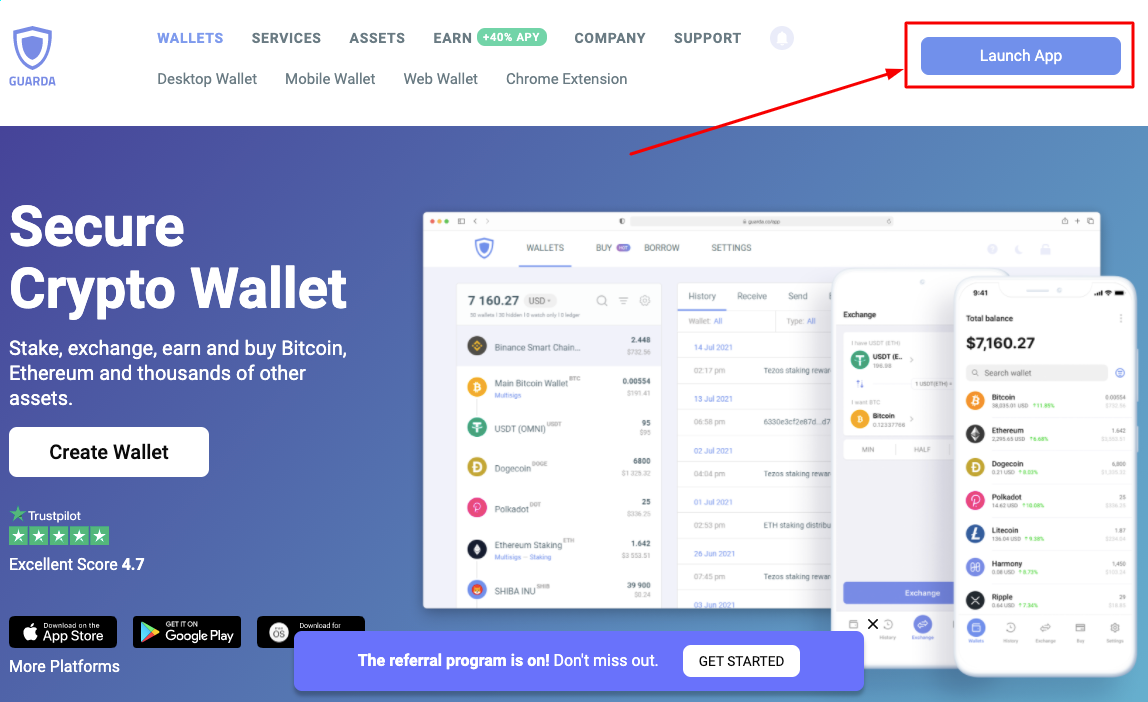
. On Guarda’s homepage, you’ll find a bright “Create Wallet” button leading you through the straightforward set-up process. According to Guarda’s website, you can download this wallet on any of the following desktop and mobile systems:
MacOS
iOS
Windows
Debian
Linux
Android
Chrome extension
AppGallery
Ubuntu
Once you’ve chosen your preferred operating system, Guarda will prompt you to create a password for your new wallet. The password you choose will automatically link to your wallet’s encrypted private key, which serves as the “master private key” for all of the crypto in your Guarda account. The master private key in your Guarda Wallet gives you complete control over the cryptocurrencies in your account, so it’s extremely important to keep it secure. Guarda asks new users to take their time creating a
strong password
and to write it down before moving on to the next step.
After writing down your password, your Guarda Wallet will supply you with a “backup file” in a TXT format. As the name suggests, the backup file contains the necessary information on your private keys, and you can use it to recover your Guarda Wallet. Download your backup file and store it in a safe place, such as an encrypted USB drive.
Once you have your secret passphrase and backup file in secure places, your Guarda Wallet should be ready for transferring, storing, staking, and purchasing cryptocurrencies. If you have any issues creating a Guarda Wallet account, consider contacting a Guarda customer care member via their
official Contacts page
.
How Do You Recover Crypto From a Lost Guarda Wallet?
As mentioned above, each Guarda wallet has two vital pieces of information:
Password
Backup file
If you break your phone or computer and need to re-download your Guarda Wallet, first visit Guarda’s official website and click either “Create Wallet” or “Sign In.” Instead of creating a new Guarda account, select “Restore or Import” to recover your lost Guarda account. On this page, you must place your backup file in the provided field and type your password. After you click the “Restore” button, your old Guarda account should appear on your computer screen or mobile device.
Can’t Get Into Your Guarda Wallet? Reach Out to ReWallet!
If you’re having difficulty recovering your Guarda Wallet, there may be ways ReWallet’s team can help you get into your account. For instance, if you have an incorrect passphrase or a corrupted backup file, it’s still possible to restore a Guarda Wallet. The only instance where ReWallet can’t help clients is if they’ve misplaced their backup file.
Anyone struggling to recover crypto in their Guarda Wallet should consider contacting professional
wallet recovery services
like ReWallet to assess their individual situation. After reading about your situation, an expert from ReWallet’s team will let you know what’s going on with your wallet and the best way to move forward.
Bruno Krauss
Co-founder and CTO Bruno is a crypto native. Long before the public hype around Bitcoin, Ethereum & Co, Bruno was already active in crypto. The idea for ReWallet originated from losing access to his own wallet.